Organisations have invested heavily in compliance over the past few years. Standards, policies, risk assessments, audits, dashboards, GRC platforms and consultancy engagements. Sound familiar?
At the same time, the EU continues to increase regulatory pressure through new and updated legislation: GDPR, NIS2, the AI Act, MDR, CRA, and DORA. Each comes with its own requirements for information security, privacy, governance and accountability. The compliance agenda continues to grow, while available resources typically do not.
Yet in practice, we continue to see the same pattern.
Compliance remains the domain of a small group of specialists. Whether focused on quality, security, privacy, or AI, the compliance officer is responsible for the management system but depends on the entire organization to make it work. Employees often perceive compliance as something that exists alongside their daily responsibilities: an obligation rather than an integrated part of their work.
They collect evidence manually, maintain risks in separate spreadsheets, and file approved policy documents away in digital drawers. A few weeks before an audit, the same ritual begins: everyone scrambles to gather evidence, actions, and documentation.
Sound familiar?
The problem is not a lack of knowledge
There is no shortage of information about compliance. Most organisations know which laws, standards, and regulations are relevant to their context. The real challenge lies in translating those requirements into day-to-day operations.
How do you ensure that policies, risks, controls, and evidence do not exist in isolation, but become part of the way the organisation actually works?
In practice, we often see the same pattern:
-
Risks maintained in spreadsheets
-
Policies stored in standalone documents
-
Improvement actions buried in inboxes
-
Compliance evidence scattered across departmental applications
-
Limited communication between compliance disciplines
And the GRC platform? That's where the compliance specialists work. The rest of the organisation rarely engages with it unless repeatedly reminded.
The result is that compliance becomes a shadow organisation: a parallel universe that seems to exist primarily for auditors, regulators, and certification bodies.
Why existing solutions fall short
We generally see three dominant approaches in the market:
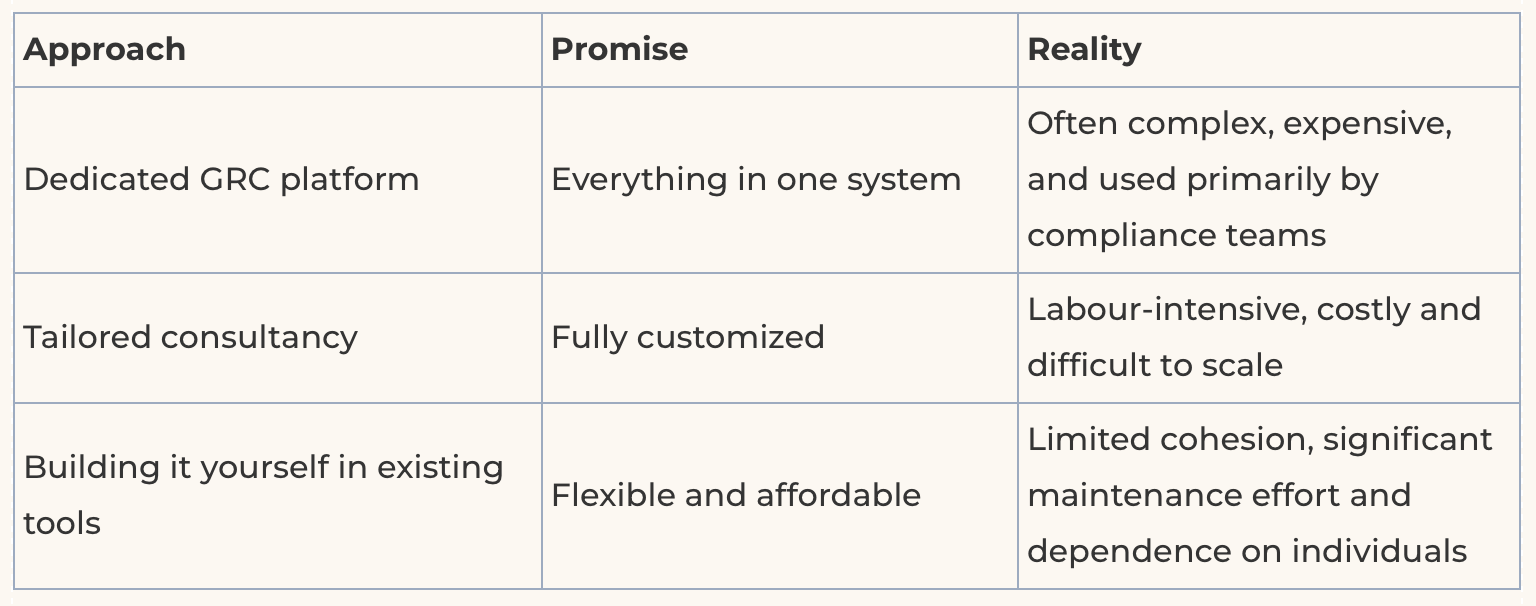
The core problem is the same in each approach: they try to bring people to compliance instead of bringing compliance to people. Employees often do not understand why an activity matters. Which risk does it mitigate? Which requirement does it address? What happens if the activity is not performed?
Without that context, compliance quickly becomes perceived as administrative overhead.
This explains why adoption so often falls short. People do not work in the compliance platform. They work in their own processes, projects and systems. As long as that remains true, compliance will continue to be viewed as "someone else's responsibility."
The question, therefore, is not how to add more compliance functionality. The real question is how to make compliance part of the way people already work. For organisations that use Atlassian, or are open to an integrated approach, that question often leads to the same conclusion: why should compliance live in a separate environment when documentation, collaboration and task management already happen elsewhere?
A different approach: making compliance part of everyday work
The future of compliance is not more functionality. It is better adoption. Not another tool, but an approach that embeds compliance into the way organisations already operate.
For many organisations, Atlassian Confluence and Jira are already the central platforms for documentation, decision-making, collaboration and operational work. Because employees already use these tools daily, many of the adoption challenges associated with traditional GRC solutions simply disappear. Why manage compliance outside that environment?
With that idea in mind, we developed the ICTRecht GRC Blueprint. Built on insights gained from dozens of compliance implementations, audits and governance programmes. It provides a practical foundation that helps organisations demonstrate compliance with information security, privacy and related regulatory requirements more quickly and effectively.
What the GRC Blueprint offers
The GRC Blueprint is not a GRC platform. It is a ready-to-use governance, risk and compliance solution built on Atlassian Cloud, based on three core principles.
1. Embedded in daily work
Confluence for policies, processes, work instructions and knowledge management. Jira for tasks, controls, reviews and follow-up actions. No separate system that pulls employees away from their day-to-day work.
2. Structure over functionality
Policies, risks, controls and compliance requirements are interconnected through linked records and relationships. This creates a direct line of sight between policies, risks, controls and compliance requirements, making it easier to understand why a control exists, which risk it mitigates and which requirements it supports.
3. Evidence by design
Controls, reviews and improvement actions become part of normal operational processes. As a result, evidence is generated during everyday work instead of being collected shortly before an audit. What is performed today becomes tomorrow's audit evidence.
The Blueprint includes, among other things:
-
Reusable templates for policies, processes and work instructions
-
Database structures for risks, controls, assets, requirements, authorizations, processing activities and responsibilities
-
Integration with Jira for operational follow-up
-
Jira automations for planning and reporting
-
An implementation approach based on the PDCA cycle
-
User documentation to support self-sufficient teams
Importantly, the Blueprint provides the structure and templates. Your organisation remains responsible for defining its own risks, controls and organisational context. We can support that process, but you can also do it independently.
Not a six-month implementation project. A working foundation within just a few days. And a structure that evolves alongside new standards, regulatory requirements and customer demands.
Making compliance part of the business
With the right structure, compliance becomes an integral part of the way organisations operate: visible, manageable and demonstrable.
The GRC Blueprint does not eliminate the need for judgement. Organisations still need to assess risks, define policies and make informed decisions.
It provides a framework that allows you to start faster, demonstrate compliance more easily and scale in a controlled manner. Built on more than twenty years of experience translating complex regulatory requirements into practical implementation.
Compliance does not have to be a shadow organisation. When policies, risks, controls, evidence and improvement actions become part of everyday operations, being demonstrably in control becomes significantly easier.
Want to learn more about the programme and investment? Download the brochure or visit our webpage for all the details.
Curious what this could look like in your Atlassian environment? Schedule a demo. Within 30 minutes, you'll know whether the ICTRecht GRC Blueprint is the right fit for your organisation.



/27.png?width=600&height=300&name=27.png)

/17.png?width=600&height=300&name=17.png)