ICT systems form the beating heart of many organisations today. From hospitals to transport companies, and from consultancy firms to financial institutions: a single bug, vulnerability or outage in a critical ICT system can disrupt business processes or cause significant financial damage. Sound contractual arrangements are therefore essential. In this blog series we reflect on common mistakes made when negotiating and concluding an ICT contract, with the aim of protecting both customers and suppliers from excessive risks.
Key considerations during the contract formation process
In the first part of this series we focused on the selection of a supplier. Once a supplier has been selected, the next step is to conclude an agreement. In this second part of the series, we zoom in on the contract formation process. When do you start with contract negotiations, and which people should you involve? The way this process is organised, can have a major impact on the outcome of the negation. In this blog, we discuss the most important pitfalls.
Pitfall 1: presenting legal wishes (or requirements) too late
Customers of ICT services have a tendency to only start working on the contract at the very last moment. Considerable time is first spent on a technical exploration, drafting a project plan and discussing commercial details. Once everyone is ready to start, the parties still need to agree on the legal terms. In our view, it is illogical to wait with legal discussions until the very last moment. Legal terms, technical requirements and commercial arrangements cannot be treated in isolation. Agreements on price (what may the solution cost?), quality (what must ultimately be delivered?) and liability (which party bears certain risks?) are communicating vessels. It is, for example, not very practical to ask a supplier to quote a price if it is not yet clear what the customer expects in terms of the applicable service level.
Apart from this fundamental issue there is also a strategic argument to start legal discussions at an early stage, at least from the customer’s perspective. As long as no final choice has been made for a specific supplier, the customer simply has a stronger negotiating position. The supplier knows that the deal is not yet done and will therefore be more inclined to make concessions. If the supplier scrutinises every contractual detail, there is a risk that the assignment will be awarded to a competitor. Our advice is therefore to start working on the contract in an early stage. As a customer, you could, for example, share your purchasing conditions during the RFP-phase.
Pitfall 2: not approaching the negotiations as a team
Especially for larger ICT contracts, a multidisciplinary approach is essential. Lawyers, project managers, budget holders, system architects and other experts each bring their own expertise. Only when these specialists work together can an optimal negotiation outcome be achieved.
In practice, there is often insufficient cooperation, and individuals with specific knowledge focus on individual parts of the contract. The IT department focusses on the security schedule, a lawyer reviews the general terms and conditions, and the project manager works on the project plan. Sometimes, this approach is driven by the idea that it is better to keep lawyers at a distance. Lawyers are expensive and tend to see obstacles everywhere. If this sounds familiar, it may be time to look for a different lawyer. An experienced lawyer understands that commercial negotiations are not a contest and that, alongside the Dutch Civil Code and the GDPR, other interests must be taken into account as well.
Being part of the contracting team, the lawyer should review the entire agreement, including its schedules. This means not only the framework agreement or general terms and conditions, but also the SLA, project plan and information security policy. Arrangements on liability and rescission of the agreement are of little value if the technical requirements are unclear and the project planning is insufficiently defined. Before you can claim damages or rescind the agreement, you will generally first have to demonstrate that the supplier is in default. This is often where things already go wrong: responsibilities are not clearly allocated and it is not entirely certain what can be expected from the supplier. If such fundamental topics are unclear, the question is whether you will ever be able to fall back on the liability or rescission arrangements at all.
Another disadvantage not working together as a team, is that no one probably has a clear view of the big picture. Before negotiations even begin, it must be clear which interests are at stake so that these can be addressed strategically. It should be borne in mind that the lawyer often operates at a distance from the project organisation. Without proper consultation, there is a risk that important context or information is missed. It can be very valuable for the involved specialists to consult with each other regularly and to review each other’s work.
Pitfall 3: making the contract larger than necessary
Parties sometimes tend to make ICT projects unnecessarily large and complicated. It may sound efficient to conclude a single contract with one supplier and to address an automation need in one go. However, the more extensive the project, the greater the risk that the finish line will not be reached, or at least not without a hitch.
There are several reasons for this. The more complex the solution, the harder it is to foresee all risks at the outset. In addition, a large ICT project will typically involve many stakeholders, each with their own wishes and priorities. This increases the likelihood that adjustments will be needed along the way. The lead time of the project is another important, and sometimes underestimated, factor. The longer a project runs, the greater the chance of unforeseen circumstances arising. These circumstances can take many forms, ranging from geopolitical tensions to an economic crisis, and from a pandemic to a company takeover. Such events may cause interests and priorities to shift along the way.
In light of the above, it can be worthwhile to consider whether the entire project really needs to be placed under a single contract. In some cases, it is more attractive to split a project into several smaller projects. If that is not possible, there might be other ways to mitigate risks. Examples include carrying out an initial baseline assessment under a separate contract, starting with a proof of concept or agreeing on clear ‘go or no-go’ moments.
Pitfall 4: misusing letters of intent and term sheets
Sometimes parties choose to first enter into a letter of intent before starting on the contract itself. A letter of intent can be a useful instrument to record process-related arrangements, such as exclusivity during negotiations, confidentiality or negotiation timelines. Parties sometimes underestimate, however, that a letter of intent can already be legally binding, depending on its contents. A letter of intent may already include substantive agreements (e.g. price arrangements, deadlines and arrangements on intellectual property rights). The question then arises whether the document does not in fact already constitute a binding agreement.
Another document that is sometimes used during the precontractual phase, is a so-called ‘term sheet’. The idea behind a term sheet is not to draw up a complete contract immediately, but to first identify the key topics, often in table form, and to enter discussions on that basis. Both parties can put their positions on the table, after which they work towards a compromise. Once the parties have agreed on the main points, further details can be worked out in a contract. Below is a simplified example of how this might look in practice:
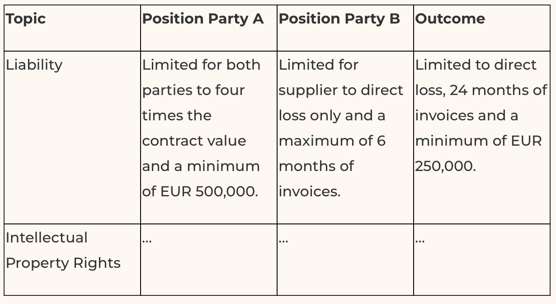
The idea behind a term sheet is to speed up the process. Parties do not immediately get bogged down in discussions on technical details, but first ensure that everyone is on the same page. Drafting the actual contract should then be little more than a formality. The difficulty, however, lies in finding the right level of detail. In the example above, a liability cap of “24 months of invoices and direct loss only” may seem clear at first glance, but there is a good chance that the supplier has a different understanding of what constitutes ‘direct loss’ than its customer.
Other blogs in this series
Would you like to learn more about pitfalls in ICT contracts? See here part 3.



/58.png?width=600&height=300&name=58.png)

/63.png?width=600&height=300&name=63.png)